Author Guidelines
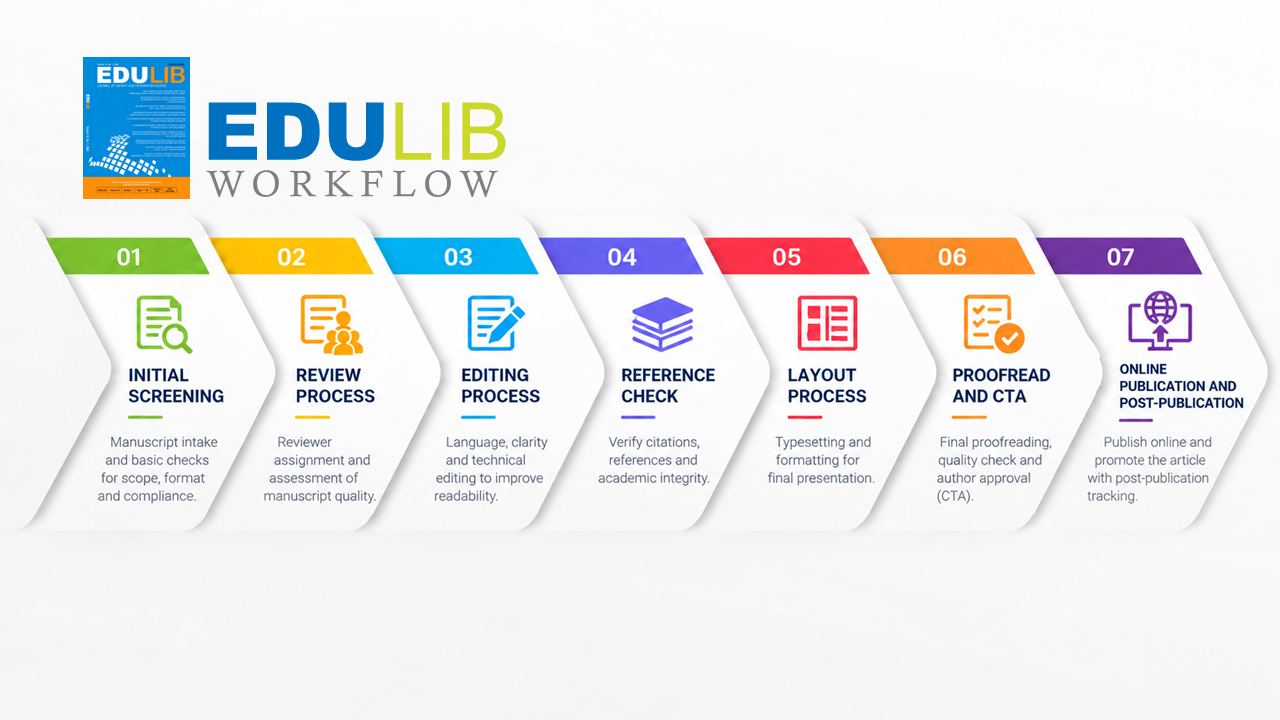
1. Submitting Your Manuscript
Manuscripts are submitted through the online system at https://ejournal.upi.edu/index.php/edulib. Register as an author and follow the five-step submission process, uploading the manuscript as a Microsoft Word file (.doc or .docx) built on the current Edulib template. Manuscripts that do not meet the requirements below are returned to the author before review. Correspondence concerning a submission is directed to the corresponding author at the address given in the manuscript.
2. Language, Length, and Page
Manuscripts are written in English and run to 5,000–7,000 words, excluding the reference list. The text is set on A4 (210 x 297 mm), single column, with margins of 2.5 cm at the left, right, and bottom and 2 cm at the top.
The first page carries the journal masthead; every following page carries a running head with the author's surname, a short title, and the page number.
3. Manuscript Structure
The manuscript contains the following elements, in this order: (a) title; (b) author names, without academic titles; (c) affiliation and country; (d) correspondence email; (e) abstract and keywords; (f) introduction; (g) methods; (h) results and discussion; (i) conclusion; (j) authors' note; (k) references.
4. Formatting Specification
| Element | Formatting Specification |
|---|---|
| Body text | Calibri 12 pt, single line spacing, no space before or after paragraphs |
| Paragraphs | First line indented 0.5 cm |
| Title | Constantia 16 pt, bold, first letter of each word capitalised, centred, 12 words maximum, no terminal punctuation |
| Author names | Calibri 10 pt, centred, without academic titles |
| Affiliation & Email | Calibri 10 pt, centred |
| Abstract | Calibri 12 pt, single spacing, 150–200 words |
| Keywords | Calibri 9 pt, single spacing, 3–5 words, alphabetical, separated by a comma and a space, closed with a period |
| Section headings | Uppercase, bold, numbered 1 to 6, left aligned |
| Subsection headings | Bold, first letter of each word capitalised, one level only (3.1, 3.2) |
| Figure caption | Below the figure, sentence case, numbered with Arabic numerals |
| Table caption | Above the table, sentence case, numbered with Arabic numerals |
| Table header row | 11 pt, bold, centred |
| Table body | 10.5 pt |
| References | Calibri 12 pt, single spacing, APA 7th edition, alphabetical, hanging indent 1 cm |
5. Title, Authors, and Affiliation
The title states the problem concisely, contains no uncommon abbreviations, runs to twelve words or fewer, and is set in Constantia 16 pt bold, centred, with the first letter of each word capitalised.
Author names appear without academic degrees or professional titles. The corresponding author is listed first and marked with an asterisk (*). The affiliation gives the institution and the country. The correspondence email is given on the line beneath the affiliation:
6. Abstract and Keywords
An abstract should stand alone, meaning that no citations are included in the abstract. Consider it the advertisement of your article. The abstract should tell the prospective reader what you did and highlight the key findings. Avoid using technical jargon and uncommon abbreviations. You must be accurate, brief, clear, and specific. Use words that reflect the precise meaning. The abstract should be precise and honest. Please follow word limitations (100–200 words) and provide up to 3 keywords.
Keywords are the labels of your manuscript and critical to correct indexing and searching. Therefore, the keywords should represent the content and highlights of your article. Use only those abbreviations that are firmly established in the field. Each word/phrase in keywords should be separated by a semicolon (;).
7. Introduction
In the Introduction, authors should state the objectives of the work at the end of the section. Before stating the objective, authors should provide adequate background and a concise literature survey to record existing solutions/methods, show the best of previous research, identify main limitations, outline what is hoped to be achieved (solving the limitations), and demonstrate scientific merit or novelties. Avoid detailed literature surveys or summaries of results. Literature surveys should not be presented author by author, but rather grouped by method or topic reviewed.
8. Methods
Methods should enable readers to reproduce the experiment. Provide sufficient detail to allow the work to be reproduced. Methods already published should be indicated by a reference; only relevant modifications should be described. Do not repeat details of established methods.
9. Results and Discussion
Results should be clear and concise, summarizing scientific findings rather than providing excessive data details. Highlight differences between your results and previous publications. Discussion is the most critical section where you present your data's significance. Start with a brief summary of main scientific findings, link results to original objectives (what/how), provide scientific interpretations (why), and compare with existing reports (what else).
10. Conclusions
Conclusions should answer research objectives and show how the work advances the field. Provide clear scientific justification, potential applications, extensions, and suggest future research. Avoid simply repeating the abstract or listing experimental results.
11. Mandatory Declarations & Statements
- Acknowledgment: Recognize individuals or funding bodies who supported the research (advisors, financial supporters, proofreaders, etc.). Do not acknowledge listed authors.
- Declaration of AI-assisted technologies (mandatory): State tool name, version, and purpose (e.g., "The author(s) used [Tool Name, Version X] for [purpose]"). If no AI was used, declare: "The authors declare no AI-assisted technologies were used in this work."
- Funding information (mandatory): Specify funding sources and grant numbers. If unfunded, state: "The authors declare that no funding was received for this study."
- Author contributions statement (mandatory): Adopt CRediT taxonomy for fair attribution. Submissions should feature direct involvement in research areas and drafting stages.
- Conflict of interest statement (mandatory): Declare any financial/non-financial associations. If none exist, state: "Authors state no conflict of interest."
12. References (APA 7th Edition)
Use reference managers such as EndNote, Mendeley, or Zotero. Manuscripts must include a minimum of 30 references, with at least 80% originating from scientific journal articles. Check each reference against the original source (author, volume, issue, year, DOI).
Reference Examples:
Book: Lumby, J. (2001). Who cares? The changing health care system. Allen & Unwin.
Book Chapter: McKenzie, H., et al. (2008). Explaining the complexities of nursing practice. In I. Morley & M. Crouch (Eds.), Knowledge as value (pp. 209-224). Rodopi.
Journal Article: Boughton, M., & Halliday, L. (2008). A challenge to the menopause stereotype. Health & Social Care in the Community, 16(6), 565-572. http://dx.doi.org/10.1111/j.1365-2524.2008.00777
Webpage: Welch, N. (2000). Toward an understanding of the determinants of rural health. Retrieved from http://www.ruralhealth.org.au/welch.htm
Reports: Magner, L. (2016). IBISWorld industry report OD5381. Coffee shops in Australia. IBISWorld Database.
- Grammarly: www.grammarly.com
- Turnitin: http://turnitin.com